Abstract
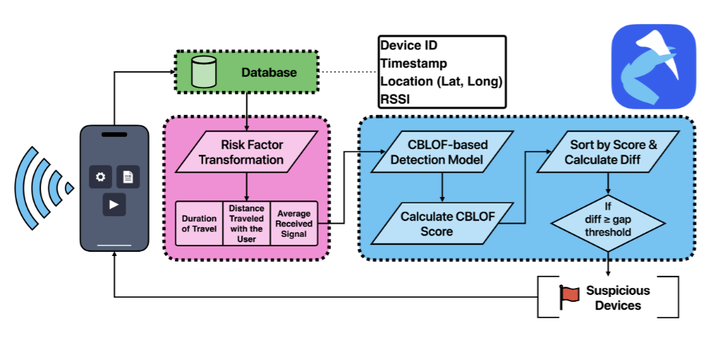
Detecting malicious Bluetooth Low Energy (BLE) trackers remains challenging because existing approaches rely on fixed time and distance thresholds that are brittle across environments. These heuristics produce false positives in dense environments and require long observation windows before flagging a device. To address these limitations, we present BL(u)E CRAB, a cross-platform (iOS/Android) mobile system that represents nearby devices using three risk factors derived from BLE scan data. Our detection model adapts Clustering-Based Local Outlier Factor (CBLOF) to BLE tracker detection and adds a gap-thresholding mechanism to separate high-scoring outliers from the benign majority. Across micro-benchmarks and end-to-end case studies, CBLOF reduces false positives up to 77% and false negatives up to 20% compared to the state of the art. In our case studies, suspicious trackers are typically detected within 5 minutes of scanning, improving practical usability for real-world deployment.

Primal Pappachan
Assistant Professor
My research interests include data management, privacy, and Internet of Things.

Roberto Yus
Assistant Professor
My research interests include Data Management, Knowledge Representation, the Internet of Things, and Privacy.