Abstract
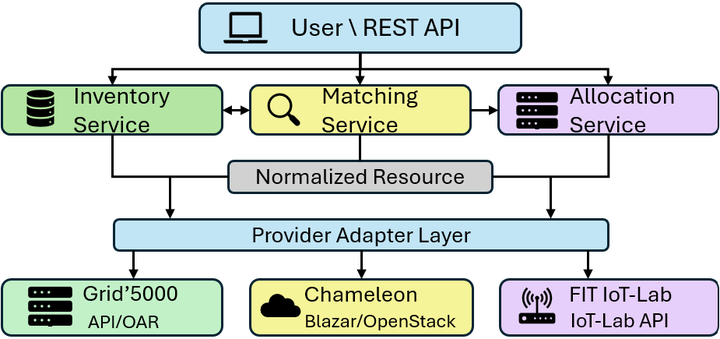
Modern AI applications increasingly run on geographically distributed and heterogeneous infrastructures that combine high-performance computing (HPC) systems, cloud platforms, and resource-constrained edge devices. Research testbeds provide such infrastructure, but their heterogeneous provisioning mechanisms, networking models, and deployment workflows complicate the development and execution of a single application across several of them. This paper reports the experience of deploying the same Federated Learning (FL) application across four widely used testbeds: Grid'5000, Chameleon, SLICES, and FIT IoT-LAB. We follow a progressive methodology, from single-testbed to three-testbed deployments, and we integrate constrained IoT nodes through a proxy-based architecture that keeps local training on the device while moving the FL runtime to the gateway. From the lessons learned, we design and implement a lightweight middleware that exposes provider-independent resource discovery, requirement-based matching, and allocation through a unified REST API, and translates these operations into the native reservation mechanisms of each testbed. We validate the middleware through live allocations on three infrastructures and an end-to-end cross-testbed FL run, and extract a set of practical guidelines for cross-testbed FL deployment.

Roberto Yus
Assistant Professor
My research interests include Data Management, Knowledge Representation, the Internet of Things, and Privacy.

Georgios Bouloukakis
Assistant Professor
My research interests include middleware, internet of things, distributed systems.